
Github available software packages
-
IP-PDT: Identity-Paired Progressive Depth Training — When Trainability Persists Beyond Expressibility (Python / PennyLane)
Athanasios Hadjidimoulas, Tirthak Patel, Anastasios Kyrillidis. arXiv:2607.16800, 2026.
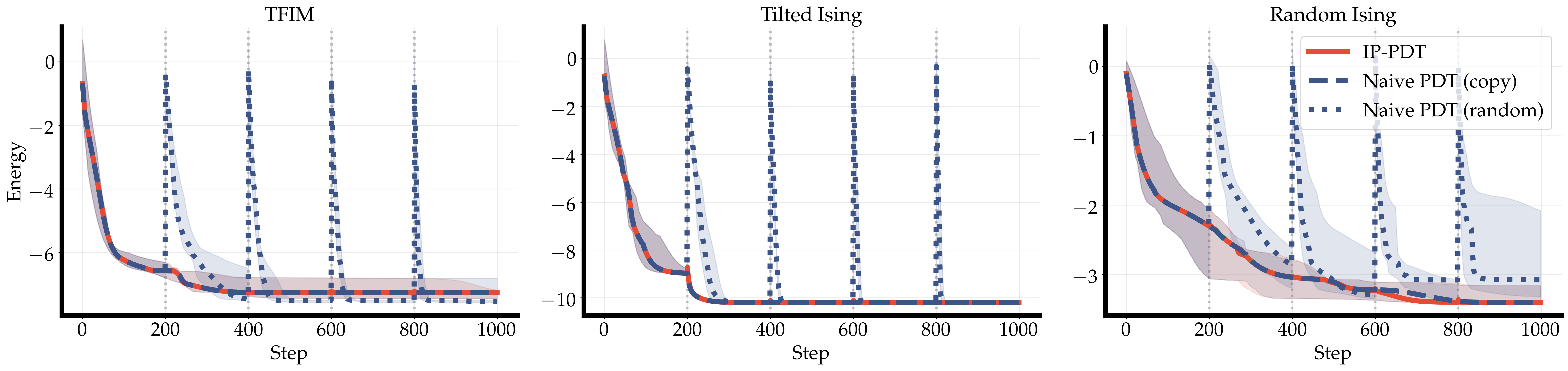
Variational quantum eigensolvers are trained by growing a circuit deeper, but in hardware-efficient ansätze the entangling CNOT gates cannot be switched off — so every appended layer irreversibly commits to more entanglement and spikes the energy just minimized (an initialization shock that can erase prior progress). IP-PDT appends instead a matched forward/inverse block pair that composes to the identity at initialization: each stage begins exactly where the previous one succeeded, and because the adjacent CNOT rings cancel, the effective circuit retains a single entangling layer wrapped in overparameterized single-qubit rotations. We prove a Reachable Set Saturation Theorem — the variational manifold expands exactly once and then saturates, so all further depth is pure overparameterization — yet progressive training keeps improving the result (trainability beyond expressibility), and we pair it with a monotone-energy guarantee and spectral-gap fidelity bounds. On structurally simple ground states IP-PDT matches or beats full-depth baselines with about 5× fewer two-qubit gates, wins on 7 of 9 benchmark Hamiltonians, and stays trainable at n=16 where the hardware-efficient baseline collapses. We map the regime of validity explicitly: the gains come mostly from the progressive curriculum (identity-pairing is the enabling architecture, not a trainability serum), the convergence guarantee is an inheritance result vacuous in the barren regime, and near criticality — where the ground state leaves the single-entangler reachable set — deeper entangling circuits are still required.
-
G-DEQ: Guided Deep Equilibrium — Decoupling Basin Selection from Equilibrium Precision for Learned Atomic Relaxation (Python/PyTorch)
Yifei Zhang, Evan Dramko, Anastasios Kyrillidis. Preprint, 2026.
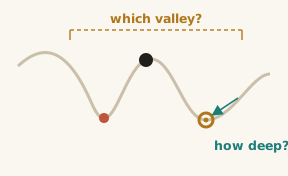
Relaxing a candidate atomic structure to its nearest energy minimum — the expensive inner loop of materials discovery — is an iterated fixed-point map: a machine-learned interatomic potential applied for many steps until the forces vanish. Training through that relaxation forces a trade-off: backpropagation-through-time steers which basin the structure lands in but stores every step (each a full neural-network evaluation over every atom, so memory grows with trajectory length), while implicit differentiation is constant-memory but only sharpens whichever minimum it already reached. We show these are two separable jobs. A short unrolled guidance phase selects the basin at O(K) memory; an implicit equilibrium phase settles precisely at O(1) memory — so the memory footprint becomes a tunable knob rather than a fixed cost. On silicon point defects the decomposition matches full backpropagation-through-time at 3.5× less memory and reaches more correct minima (85 of 100 basins vs 79), a controlled analysis showing the advantage is basin selection rather than a memory optimization. We also map the method's regime of validity — correct base forces, genuinely competing minima, a base that lands in the wrong one, and a short relaxation — turning "when does trajectory-level training help?" into a checkable guide across the machine-learned-potential dataset landscape, with a shared vocabulary bridging machine learning and materials science.
-
ORAT: One Rank at a Time — Cascading Error Dynamics in Sequential Learning (Python / NumPy / SciPy)
Mahtab Alizadeh Vandchali, Fangshuo (Jasper) Liao, Anastasios Kyrillidis. Transactions on Machine Learning Research (TMLR), 2026 (in press). arXiv:2505.22602.
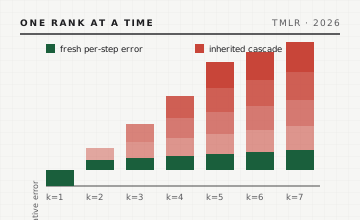
When low-rank models are fit one rank-1 component at a time — the canonical mode of LoRA fine-tuning, deflation PCA, and orthogonal matching pursuit — per-step numerical errors compound geometrically through every later step. The amplification is governed by the spectral gaps of the output matrix Y. We prove this for fixed-design linear regression (three theorems on training error, noiseless parameter recovery, and Gaussian-noise recovery) and derive a one-parameter family of compute-allocation schedules; the "more-first" schedule with α ≈ 1.5 saturates the empirical optimum. Exploratory probes on vision LoRA (MNIST / CIFAR-10 / CIFAR-100) and language LoRA (DistilBERT / SST-2) show the qualitative pattern transfers across domains. The first sequential rank-1 component on SST-2 already matches jointly trained rank-3 LoRA at 0.872 accuracy. Honest scope: an explanatory framework, not a benchmark-beating method.
-
AIR: Asymmetric Input Recurrence — One Model, Two Roles in a Shared Recurrent Transformer (Python/PyTorch)
Jucheng Shen, Barbara Su, Anastasios Kyrillidis. Preprint, arXiv:2605.17811, 2026.
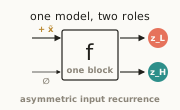
Can a shared-weight recurrent Transformer develop distinct internal roles without being partitioned into separate modules? AIR is a minimal two-state reasoning architecture in which the same Transformer block is reused for both updates, and the only built-in asymmetry is that the encoded input is injected during L-updates but not H-updates. Across Sudoku-Extreme and 30×30 mazes, decoded rollouts show a stable split: zH behaves like a fully-committed proposal state while zL retains local uncertainty and shifting intermediate structure. Freeze experiments confirm the two states are coupled (collapsing either drops final accuracy to zero), and attention analysis shows L-updates are ~47% more local than H-updates at the deepest layer. With half the parameters of the two-network HRM baseline, AIR matches or exceeds it on both tasks (60.0% vs 55.0% on Sudoku, 75.6% vs 74.5% on Maze). A level-token control further shows the load-bearing requirement is a structurally separable state-identity signal, not input injection specifically.
-
AdaPaD: Adaptive Parallel Deflation for PEFT with Self-Correcting Rank Discovery (Python/PyTorch)
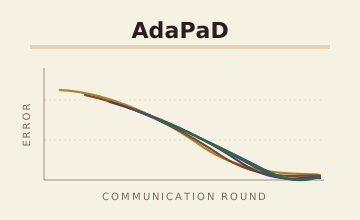
Barbara Su, Fangshuo (Jasper) Liao, Anastasios Kyrillidis. Preprint, arXiv:2605.10741, 2026.
For ninety-two years the convention has been to extract rank-one components sequentially — Hotelling's 1933 deflation, in essence. We show that running all r workers in parallel, with each worker rebuilding its deflation target from the latest estimates of its predecessors every round, makes the deflation mismatch vanish exponentially rather than freezing at predecessor finish. The proof carries from PCA to bilinear regression — the setting that underlies LoRA — via Wedin's theorem. On top of the parallel backbone, AdaPaD adds advance learning and per-module dynamic rank discovery, so the rank distribution is an output rather than an input. On the eight tasks of GLUE with DeBERTaV3-base at matched 0.34M-parameter budget, AdaPaD achieves the best average score (89.34); on four H200 GPUs at rank 64, the per-batch wall-clock speedup is 3.62×.
-
GHOST: Grouped Hidden-state Output-aware Selection and Truncation — State Pruning for Mamba2 Selective State-Space Models (Python/PyTorch)
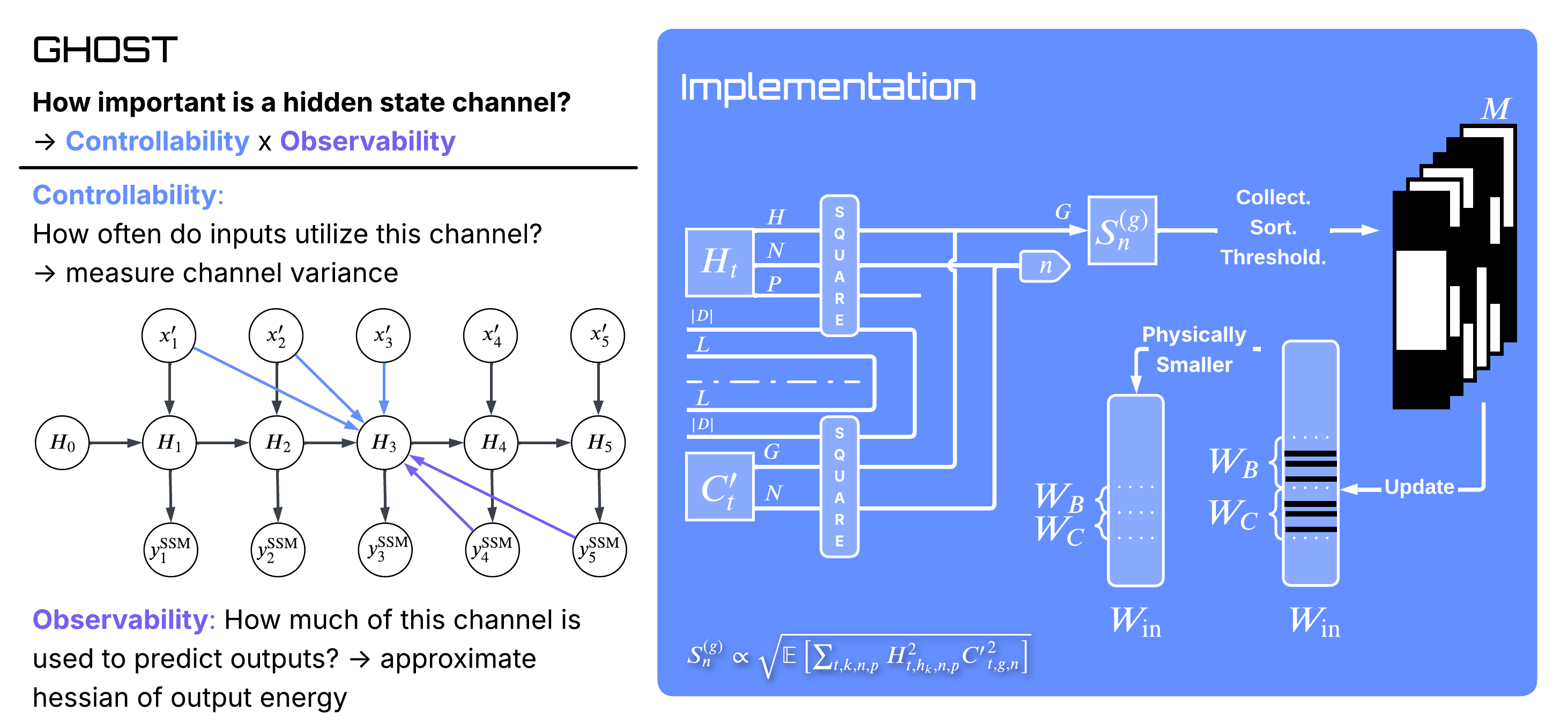
Michael Menezes, Anastasios Kyrillidis. ICML 2026 (Seoul).
While Mamba2's expanded state dimension enhances temporal modeling, it incurs substantial inference overhead that saturates bandwidth during autoregressive generation. Standard pruning methods fail to address this bottleneck: unstructured sparsity leaves activations dense, magnitude-based selection ignores runtime dynamics, and gradient-based methods impose prohibitive costs. We introduce GHOST (Grouped Hidden-state Output-aware Selection and Truncation), a structured pruning framework that approximates control-theoretic balanced truncation using only forward-pass statistics. By jointly measuring controllability and observability, GHOST rivals the fidelity of gradient-based methods without requiring backpropagation. On models ranging from 130M to 2.7B parameters, our approach achieves a 50% state-dimension reduction with approximately 1 perplexity point increase on WikiText-2.
-
Stochastic Self-Stabilization at the Edge of Stability (Python/PyTorch)
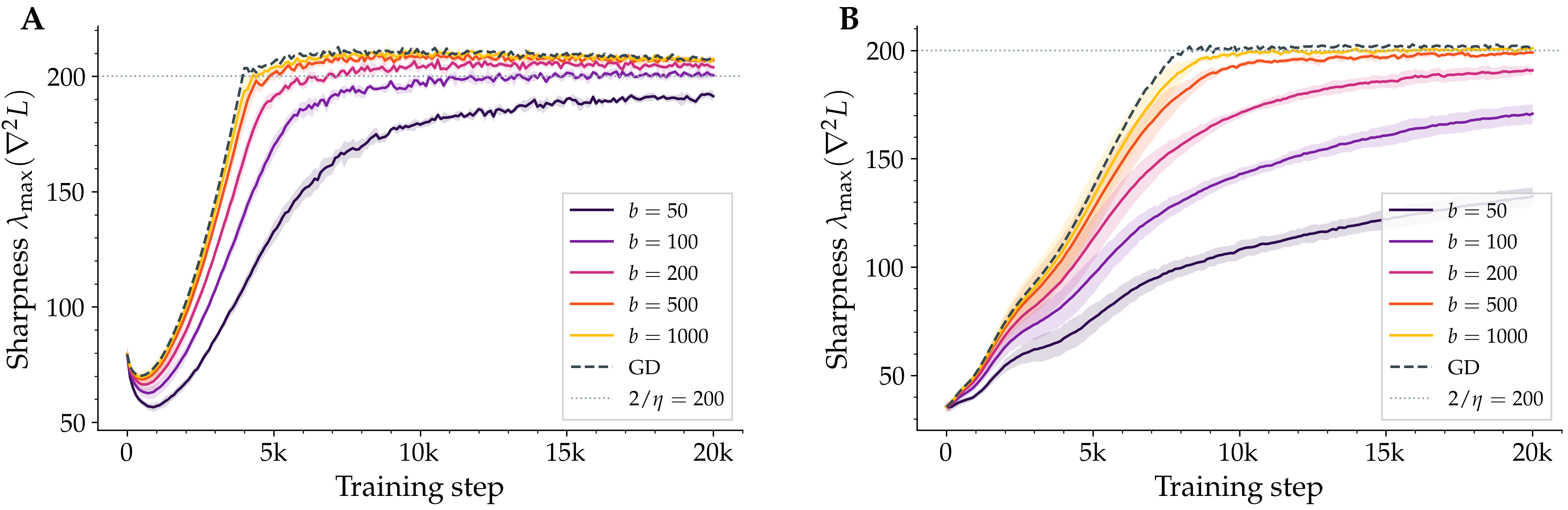
Fangshuo (Jasper) Liao, Afroditi Kolomvaki, Anastasios Kyrillidis.
Train a neural network with full-batch gradient descent and the largest eigenvalue of its loss Hessian — the sharpness — climbs to a specific value, 2/η, and pins itself there: the well-known Edge of Stability. Replace gradient descent with mini-batch SGD and the same quantity sits below 2/η, with the gap widening as the batch shrinks. We close this. Our analysis extends Damian's coupling theorem to the stochastic case and yields a closed-form sharpness gap ΔS ≈ (ηβσu2)/(4α), inversely proportional to batch size and depending on three landscape quantities — progressive sharpening rate α, self-stabilisation strength β, and the noise variance projected onto the top Hessian eigenvector. Experiments on CIFAR-10 confirm the 1/b scaling (fitted slope −1.27, R2 = 0.98) across MLP and small-CNN architectures.
-
Multiplicative Gaussian Input Noise for Two-Layer ReLU Networks (Python/PyTorch)
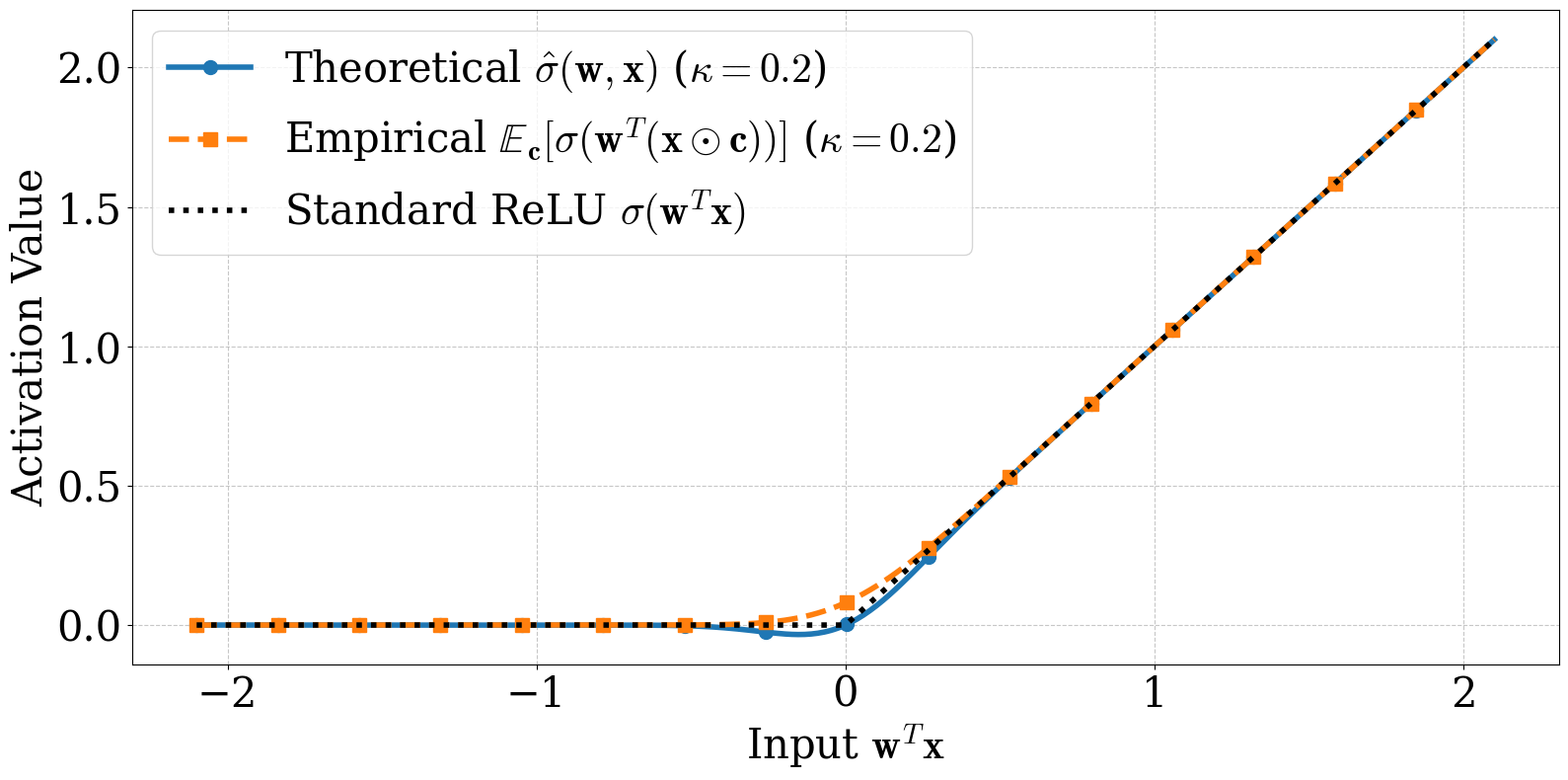
Afroditi Kolomvaki, Fangshuo (Jasper) Liao, Evan Dramko, Ziyun Guang, Anastasios Kyrillidis.
What happens when every input to a two-layer ReLU network is multiplied by an independent Gaussian random number — centered at 1, standard deviation κ, with a fresh draw at every iteration? The training loss does not blow up: it converges linearly to a target whose distance from the global minimum we can write down as a function of κ, the network width m, and the number of samples n. The technical move is a closed-form expectation: when the argument of a ReLU is Gaussian, the expected output has a clean expression z·Φ(z/σ) + σ·φ(z/σ). Plugged back into the loss, the expected loss decomposes into a smoothed-network MSE plus a κ2-scaled regularizer, both clean enough to admit an NTK-style convergence proof. Underneath the result is a general SGD theorem for biased gradient estimators with a relaxed smoothness condition.
-
Exploiting Low-Rank Structure in Max-K-Cut Problems (Python/PyTorch)

Ria Stevens, Fangshuo Liao, Barbara Su, Jianqiang Li, Anastasios Kyrillidis
We approach the Max-3-Cut problem through the lens of maximizing complex-valued quadratic forms and demonstrate that low-rank structure in the objective matrix can be exploited, leading to alternative algorithms to classical semidefinite programming (SDP) relaxations and heuristic techniques. We propose an algorithm for maximizing these quadratic forms over a domain of size K that enumerates and evaluates a set of O(n2r−1) candidate solutions, where n is the dimension of the matrix and r represents the rank of an approximation of the objective. We prove that this candidate set is guaranteed to include the exact maximizer when K=3 (corresponding to Max-3-Cut) and the objective is low-rank, and provide approximation guarantees when the objective is a perturbation of a low-rank matrix. This construction results in a family of novel, inherently parallelizable and theoretically-motivated algorithms for Max-3-Cut. Extensive experimental results demonstrate that our approach achieves performance comparable to existing algorithms across a wide range of graphs, while being highly scalable.
-
Provable Model-Parallel Distributed PCA with Parallel Deflation (Python/PyTorch)
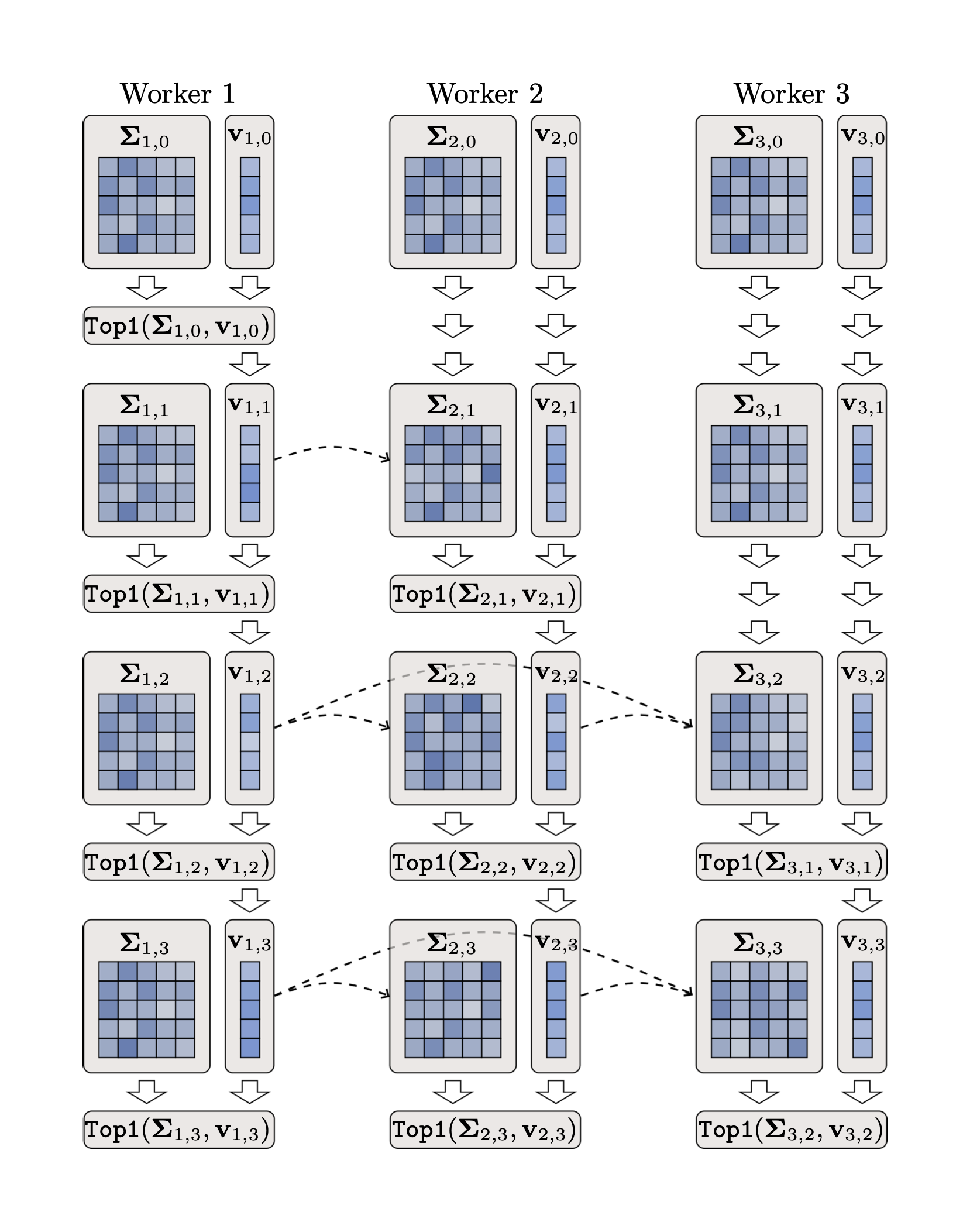
Fangshuo (Jasper) Liao, Wenyi Su, Anastasios Kyrillidis. CPAL 2025.
We introduce Parallel Deflation, a distributed PCA framework where K workers compute all K principal components simultaneously, with no sequential dependencies. Unlike prior approaches that require components to be extracted one at a time, our method provides the first provable convergence guarantees for model-parallel PCA: each component converges at a geometric rate that depends on the spectral gap, and crucially, errors from early imprecise estimates self-correct as later components improve. The algorithm achieves substantial speedups over sequential deflation while maintaining theoretical optimality, with applications including LoRA fine-tuning and large-scale matrix factorization.
Code packages (before moving to Github)
-
(Bi-) Factored Gradient Descent algorithm for low-rank recovery (Matlab)
This software package is a proof of concept for $UV^\top$ parameterization in optimization and focuses on first-order, gradient descent algorithmic solutions for the case of matrix sensing. The algorithm proposed is named as Bi-Factored Gradient Descent (BFGD) algorithm, an efficient first-order method that operates on the $U, V$ factors. Subsequent versions will include more involved applications such as 1-bit matrix completion (logistic regression objective), low-rank image recovery from limited measurements, quantum state tomography settings, etc.
-
A simple, but yet efficient, algorithm for Bipartite Correlation Clustering (Matlab)
In this code, we implement a simple, yet efficient, algorithm for the problem of Bipartite Correlation Clustering (BCC). Our algorithm solves a more generalized problem of maximizing a bilinear form, a specific instance of which is the BCC problem. In the demo included, we run our algorithm on a small movie lense dataset, in order to automatically extract useful clusters between users that have similar movie preferences.
-
ALgebraic PursuitS (ALPS) for sparse signal recovery (Matlab)
This software package implements the ALgebraic PursuitS class of methods for sparse signal recovery. ALPS framework includes some of the fastest Iterative Hard Thresholding (IHT) variants, utilizing optimal subspace exploration, cheap and adaptive step size selection and Nesterov-style accelerations. ALPS are also backed with strong theoretical guarantees, based on RIP assumptions in compressed sensing settings.
-
Matrix ALgebraic PursuitS (Matrix ALPS) for low rank recovery (Matlab)
This software package implements the Matrix ALgebraic PursuitS class of methods for low rank recovery. This set of problems includes the affine rank minimization, matrix completion and PCA settings. Similar to the vectors case, the Matrix ALPS framework includes some of the fastest Iterative Hard Thresholding (IHT) variants for low rank matrix reconstruction, utilizing optimal subspace exploration, cheap and adaptive step size selection and Nesterov-style accelerations. Matrix ALPS are also backed with strong theoretical guarantees, based on RIP assumptions in compressed sensing settings.
-
Matrix ALgebraic PursuitS (Matrix ALPS) for low rank + sparse recovery (Matlab)
This software package is the extension of the Matrix ALPS software package for the case of low rank and sparse recovery. Applications include background video subtraction and robust PCA, among others.
-
Self-Concordant OPTimization (SCOPT) for composite convex problems (Matlab)
SCOPT is a MATLAB implementation of the proximal gradient, proximal quasi-Newton, proximal Newton, and path-following interior-point algorithms for solving composite convex minimization problems involving self-concordant and self-concordant-like functions.
-
CLASH and Normed Pursuits: Hard thresholding with norm constraints (Matlab)
CLASH (Combinatorial selection and Least Absolute SHrinkage) and Normed Pursuits are new sparse signal approximation algorithm that leverages prior information beyond sparsity to obtain approximate solutions to the Lasso problem. These algorithms alters the selection process of Lasso algorithm by exploiting additional signal structure, dubbed as combinatorial sparsity model, and introduces approximate combinatorial selection with provable convergence guarantees.
-
Sparse projections onto the simplex (Matlab)
In this snippet of code, we compute sparse projections onto the simplex. Our approach is greedy, i.e., sequentially and greedily we construct the solution that $(i)$ minimizes the euclidean distance to an anchor given point, $(ii)$ "lives" on the simplex and, $(iii)$ is $k$-sparse. (The code is to be updated with some demo files).
-
Provable deterministic leverage scores sampling (Matlab)
Here, we explain in practice the curious empirical phenomenon: “Approximating a matrix by deterministically selecting a subset of its columns with the corresponding largest leverage scores results in a good low-rank matrix surrogate”. In this demo, we demonstrate empirically the performance of deterministic leverage score sampling, which many times matches or outperforms the state-of-the-art techniques.
-
Generalized Sparse Additive Models (GSPAM) with interactions in high-dimensions (Matlab)
This software package solves a d-dimensional GSPAM instance, where univariate and bivariate set of indices ($S_1$ and $S_2$, respectively) are unknowns. The code follows the steps indicated by the main algorithm, described in the conference paper.
-
Expanders and group sparse recovery (Matlab)
Proof of concept why expanders accelerate execution time of convex solvers for group sparse recovery. The problem setting is that of group sparse convex norm minimization over linear constraints. The experiments include both synthetic and real data settings.
-
Finding the M-PSK vector that maximizes a rank-deficient complex quadratic form (Matlab)
Given a rank-deficient PSD complex matrix as an input, computes the polynomial-sized set of candidate M-PSK solutions, among which the optimal M-PSK vector --that maximizes the rank-deficient quadratic form-- lies.
-
Multiway (tensor) compressed sensing for sparse and low rank tensors (Matlab)
In this contribution, we consider compressed sensing for sparse and low-rank tensors. More specifically, we consider low-rank tensors synthesized as sums of outer products of sparse loading vectors, and a special class of linear dimensionality-reducing transformations that reduce each mode individually. We prove interesting "oracle" properties showing that it is possible to identify the uncompressed sparse loadings directly from the compressed tensor data. This Matlab demo works as a proof of concept for the main ideas in the paper.